Photos by Eric Arnold
The stretch of Martin Luther King Way running from West Grand Avenue to 580 Freeway lies within one of Oakland's deadliest neighborhoods, appropriately nicknamed Ghosttown by the local residents. Homeless encampments populate the long dark stretches under the freeway overpasses. Drugs and alcohol are rampant. Dotted with liquors store and abandoned buildings, the neighborhood accumulates the more litter than the majority of the city. Nearby San Pablo Ave is haven for prostitution.
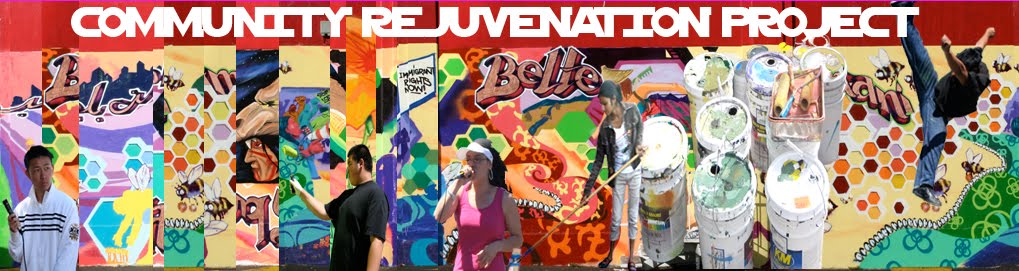
A year ago, CRP made an effort to improve the quality of life in the neighborhood for local residents. The collective painted 5 murals along a four block stretch between 22nd and Sycamore and named the area the Martin Luther King Cultural Corridor in an effort to protect their work from city abatement. The project centered on 25th and MLK. In January 2010, CRP had picked up 7 bags of trash from that corner while birthing the original mural, Oakland Celebrations, depicting Carijama, indigenous and Chinese dancers connected through the wheels of colorful scraper bikes.
The collective had observed that the mural had accumulated a large collection of signatures from a confused fan club, who seemed to think that signing their name to mural would give them credit for painting it. Mike 360 and Desi W.O.M.E went to work transforming sections of the abandoned Foster's Freeze with new pieces and covering up the "mosquito bite" signatures. Across the street, the "Love, Art and Music are the Universal Language" mural on the chain link fence had been haphazardly flipped over by construction workers who were rebuilding the park. The park had been shut down years before when it devolved into a shooting gallery for local heroin addicts. The artists had only planned on doing some maintenance on the mural and left behind their clean-up tools. Regardless, the project was too massive for two people in one afternoon. The artists repaired the front of the building and left.
A plan was made to return the following week and do a more comprehensive project. Elijah would drive up from Santa Cruz and new works would be painted on the wood fence in the lot. The art would begin on Friday and a volunteer clean-up would be organized for Saturday morning. The trash piled behind the building dwarfed the litter in the front. Vandals had struck a newly painted, yet still boarded up house, with bubble letters that reached over the windows. The entire lot was strewn with garbage ranging from moldy couches to fast food packaging. Local dopefiends gathered in the clutter to smoke their rocks out of site. Amidst the rubble, a soggy abatement notice from the city of Oakland partially protruded limply from a pile near the fence.
As Elijah and Desi began on the most prominent area of the fence, local residents began passing by and complimenting them on their work. The two artists painted throughout the afternoon, utilizing the garbage to stand on and reach the top of the fence. Elijah was interested in making a statement for the local community and Desi drew the connection between the national foreclosure crisis and the neighborhood gentrification. Desi painted the word "Divest" in an elaborate style and Elijah complimented it with a character wearing the facade of a house as his attire, representative of the basic need in the community for adequate housing. They planned to write "Bankers' Greed vs. People's Need" on the side. As the sun was going down, the artists were joined by Beats who prepared a section to the left to say "Resistance." Right before dark, the artists were visited by two police officers. Expecting their support, Desi greeted them. They were shocked when they were told to stop immediately or face arrest. The owner of the fence had complained, even though the mural faced the abandoned lot and not the man's property. Desi and Elijah had gotten verbal permission from a man sitting on the porch of the house earlier that day, so the occurrence was strange. The artists' requests to speak to the owner were repeatedly denied. The group explained the plans for the clean-up project and were ignored. The property owner's word was final. The group was ordered to paint over the mural in the morning or face arrest. Meanwhile nothing would be done about the lot, because that was a different owner's responsibility. The next morning, the artists complied with the request and painted over the mural, leaving a message questioning the city's abatement strategy in its wake.
This experience exemplifies the city's disjointed approach to community clean-up. Artist painting a mural in an abandoned lot to improve the neighborhood are ordered to stop while nothing is done to clean the enormous piles of trash at the same location. Private property owners are the only people with rights under these circumstances. When they do not comply with abatement standards, they are given meaningless notices and the trash remains. When the community attempts to transform an abandoned and blighted lot, they are pushed out because they are not the property owners, yet the entire neighborhood is affected by the neglect of a few absentee landlords. Blight reinforces the degradation of the neighborhood in the consciousness of the community. Its demoralizes and disempowers the residents. Murals on the other hand, help define the identity of the neighborhood and become a source of pride. They give people something that they want to maintain. Given the proper support, murals can transform a community without pushing out its long-term residents and raise the property values for a neighborhood without gentrification. CRP believes in a holistic strategy to abatement that included surveys, murals, community clean-up, and block parties. Its time for a new approach to the maintenance of our neighborhoods.